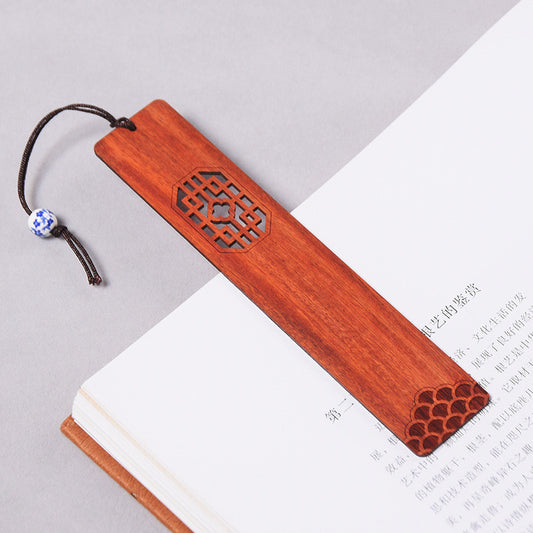
Is Your Wooden Bookmark Too Thin and Prone to Breaking?
Quick Answer
The safe thickness for wooden bookmarks is 1.0 to 1.3 millimeters. Bookmarks thinner than 0.8 mm break very easily; those thicker than 1.5 mm may damage book spines. Soft woods like cherry and basswood need at least 1.2 mm, while dense hardwoods like walnut and rosewood can go as thin as 1.0 mm.

Why Do Wooden Bookmarks Break?
Over 60% of wooden bookmark makers have encountered breakage. The three most common causes are:
- Thickness below the critical threshold — Below 0.8 mm, bending strength drops sharply. Even slight lateral force causes snapping.
- Wrong wood species — Softwoods used at thin dimensions carry extremely high breakage risk.
- Incorrect grain direction — Along-grain cuts reduce strength by more than 50% compared to cross-grain or laminated structures.
Recommended Thickness by Use Case
Use this reference table to choose the right thickness for your application:
| Use Case | Recommended Thickness | Suitable Woods | Notes |
|---|---|---|---|
| Daily Use (Adults) | 1.0–1.3 mm | Walnut, Maple, Rosewood | Best balance of strength and slimness |
| Children's Use | 1.5–2.0 mm | Any hardwood | Prioritize bending resistance |
| Gift / Premium Edition | 1.2–1.5 mm | Rosewood, Blackwood, Ebony | Surface coating adds extra strength |
| Laser Engraving / Mass Production | 1.0–1.2 mm | Basswood, Birch Plywood | Laser power must be precisely calibrated |
| Ultra-Slim Design | 0.8–1.0 mm | Only extremely dense hardwoods | High risk — generally not recommended |
- 🔴 Danger zone: Under 0.8 mm — breakage rate exceeds 80%
- 🟢 Safe zone: 1.0–1.3 mm — suitable for 90% of use cases
- 🟡 Conservative zone: Over 1.5 mm — strong, but may affect book closure
How to Test If Your Bookmark Is Strong Enough
Three simple at-home tests to evaluate your bookmark's durability:
1. Cantilever Test
Clamp one end of the bookmark to a table edge and let the other end hang freely.
- 1.0 mm — passes if it holds at 8 cm overhang without breaking
- 1.2 mm — passes at 10 cm
- 1.5 mm — excellent at 12 cm
2. Three-Point Bending Test
Support both ends 10 cm apart and press gently in the middle.
- Passes: no break at 5 mm deflection
- Excellent: no break at 10 mm deflection
- Fails: breaks at 3 mm — too thin or wood too soft
3. Torsion Test
Hold both ends and twist gently.
- Passes: resists slight torsion
- Fails: breaks when twisted — likely an along-grain cut
5 Methods to Strengthen Your Wooden Bookmark
- Choose denser wood species — Walnut, maple, and rosewood offer superior strength. Avoid basswood and pine for thin formats.
- Use cross-grain lamination — Glue two 0.6 mm veneers at 90° to achieve 1.2 mm total thickness. This doubles strength and reduces warping.
- Apply a surface coating — Water-based polyurethane, Danish oil with beeswax, or thin-layer epoxy resin all improve surface hardness and wear resistance.
- Round the corners — Sand corners to a 2–3 mm radius to distribute stress and reduce impact breakage.
- Avoid along-grain cuts — Ensure the wood grain runs at a 45–90° angle to the bookmark's long axis for maximum strength.
Frequently Asked Questions
What is the minimum safe thickness for a wooden bookmark?
The minimum recommended thickness is 1.0 mm for dense hardwoods (walnut, rosewood). For softer woods, do not go below 1.2 mm. Anything under 0.8 mm has an 80%+ breakage rate and is not recommended for practical use.
Can I make a wooden bookmark thinner than 1 mm?
Only if you use extremely dense hardwoods like rosewood or blackwood, and only with cross-grain lamination. Even then, the risk is high and the bookmark is not suitable for everyday use.
Does wood grain direction really affect bookmark strength?
Yes — significantly. Along-grain cuts are more than 50% weaker than cross-grain or laminated structures. Always orient the grain at 45–90° to the long axis of the bookmark.
What coating is best for strengthening a thin wooden bookmark?
Water-based polyurethane offers the best combination of hardness, flexibility, and ease of application. For a more natural finish, Danish oil followed by a beeswax topcoat is a good alternative.
How thick should a wooden bookmark be for children?
Use 1.5–2.0 mm for children's bookmarks. Prioritize bending resistance over slimness, and choose any hardwood species.