The Evolution of Chinese Traditional Bookmarks: An In-depth Comparison Across the Tang, Song, Ming, and Qing Dynasties
Share
Author: Xiaopeng
Update Time: April 2026
Reading Time: Approx. 7 minutes
Chinese bookmarks underwent a significant evolution from "ivory scroll tags" to "paper pasted tags" and finally to "thread-bound inner tags" across four major dynasties. The Tang Dynasty was dominated by ivory bookmarks; paper bookmarks emerged after the popularization of printing in the Song Dynasty; the standardization of thread-bound books in the Ming Dynasty shifted the bookmark's core function to marking reading progress; and the materials and craftsmanship of bookmarks reached their historical zenith during the Qing Dynasty.
I. Tang Dynasty (618–907): The Golden Age of Ivory Bookmarks
1.1 Book Binding Form: Primarily Scroll Binding
Tang Dynasty books primarily adopted the scroll binding form. According to documents from the National Library of China, books circulated mainly in scroll form from the Han to the Tang Dynasty. The hanging scroll paintings and calligraphy we see today are remnants of this ancient binding style.
1.2 Bookmark Form: Ivory Tags on Scroll Ends
Tang Dynasty bookmarks were mainly attached to the ends of the scrolls, serving highly practical and categorical functions:
- Material: Primarily made of ivory, historically referred to as "ivory tags" (Ya Qian).
- Function: Hung externally to identify the book title and volume number, facilitating quick retrieval from bookshelves.
- Color Classification: Adhered to a strict hierarchical and categorical system (e.g., red for Classics, white for History).
- Craftsmanship: Exquisitely carved, usually with the book title engraved directly onto the ivory tag.
1.3 Literary and Historical Records
Many Tang Dynasty literary works mention ivory bookmarks, confirming their popularity among the literati class:
- Han Yu's Sending Zhuge to Suizhou to Study: "The Marquis of Ye has many books, thirty thousand scrolls on the shelves. Each one features an ivory tag, fresh as if untouched by hands."
- Du Fu's Inscribing on the Wall of the Mountain Residence of the Bo Brothers: "The pen rack is stained by window rain, the bookmarks reflect the twilight through the cracks."
These records indicate that wealthy Tang Dynasty collectors considered possessing massive scroll collections with ivory tags a symbol of cultural refinement.
1.4 User Demographics
- Royal Family and Nobles: Used high-grade ivory and jade bookmarks.
- Literati and Officials: Commonly used ivory bookmarks.
- Ordinary Scholars: Mostly used bamboo and wooden bookmarks.
- General Public: Used simple paper or cloth strips.
II. Song Dynasty (960–1279): Printing Technology Drives Bookmark Transformation
2.1 Book Binding Form: Transition to Sutra and Butterfly Binding
With the widespread popularization of woodblock printing in the Song Dynasty, book forms underwent a revolutionary change:
- Traditional scroll binding was gradually phased out of the market.
- Sutra binding (concertina folding), which was easier to flip through, became widely used.
- Butterfly binding emerged and became popular, moving books toward the codex (page-bound) format.
2.2 Bookmark Form: The Rise of "Floating Tags" (Pasted Tags)
The booming printing industry in the Song Dynasty prompted a shift in bookmark materials. Bookmarks were mostly made of paper or silk, academically known as "floating tags" (Fu Qian) or "cover title tags," though the traditional term "ivory tag" was still culturally used.
- Material: Shifted to lightweight materials like paper and silk.
- Location: Pasted on the book cover or title page.
- Function: Identifying the book title, while beginning to serve the dual purpose of marking reading progress.
- Economics: Production costs dropped significantly, allowing bookmarks to spread widely among the ordinary scholar class.
2.3 Literary Records
Su Shi's Sending Registrar Ouyang to Take Office in Weicheng: "Having read through thirty thousand ivory-tagged scrolls, you now come to a small town to try your hand." (The "ivory tag" here is mostly a cultural motif; the actual material had likely evolved to paper).
2.4 Technological Driving Factors for Song Dynasty Bookmark Changes
| Driving Factor | Technological Manifestation | Impact on Bookmarks |
|---|---|---|
| Maturation of Papermaking | Increased paper yield, improved quality | Provided a cheap, easy-to-write/print medium for bookmarks |
| Popularization of Woodblock Printing | Mass production of books, surging collection sizes | Expensive ivory could not meet the massive demand, forcing a shift to more accessible materials |
| Change in Binding Form | From scrolls to pages (Butterfly binding) | Externally hung scroll tags lost their anchor, evolving into pasted floating tags |
III. Ming Dynasty (1368–1644): Standardization of Thread-Bound Books and Functional Shift
3.1 Book Binding Form: Thread-Bound Books Become the Absolute Mainstream
Historical records indicate that while early forms of thread binding existed previously, it was during the mid-Ming Dynasty that thread-bound books officially replaced wrapped-back binding as the mainstream form. Thread-bound books completely resolved the physical flaws of pages falling out found in butterfly and wrapped-back bindings.
3.2 Bookmark Form: Shift from "Outer Tags" to "Inner Tags"
The Ming Dynasty was a watershed moment for the functional evolution of bookmarks:
- Location Shift: Along with the popularization of thread-bound books, bookmarks moved from the exterior (covers/scroll ends) to the interior (placed between book pages).
- Functional Redefinition: The function of identifying book titles weakened, shifting primarily to the modern function of marking reading progress.
- Independent Form: They became independent, slip-like objects that could be taken out and put in at any time.
- Diverse Materials: A blossoming variety of materials emerged, including ivory, jade, bamboo, wood, paper, and silk.
3.3 Refinement of Craftsmanship
- Ivory Carving: Introduction of openwork, micro-carving, relief, and intaglio techniques.
- Jade Bookmarks: Focused on polishing for a lustrous finish and shallow-carved motifs.
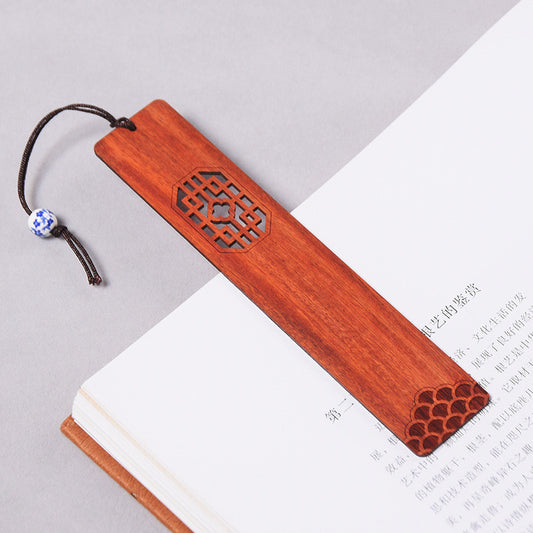
- Bamboo/Wood Bookmarks: Pyrography (wood burning) and fine shallow carving became popular.
- Paper Bookmarks: Combined woodblock water-color printing with literati hand-painting.
3.4 Cultural Significance
Under the prosperous literati culture of the Ming Dynasty, bookmarks transcended their role as practical tools and became:
- An important component of the literati's scholarly objects (Wenfang Yawan).
- Elegant social gifts exchanged among scholars and intellectuals.
- Art collection items reflecting personal aesthetics and taste.
IV. Qing Dynasty (1644–1911): The Pinnacle of Materials and Craftsmanship
4.1 Book Binding Form: Full Popularization of Thread-Bound Books
By the Qing Dynasty, the vast majority of traditional Chinese books used thread binding. Because they were extremely easy to repair and rebind, this format has been used ever since, providing a stable medium for the prosperity of inner bookmarks.
4.2 Bookmark Form: Highly Diversified and Popularized
- Extreme Wealth of Materials: Covered all usable materials in the scholar's studio, including organic gems, metals, and hardwoods.
- Pinnacle of Craftsmanship: Combined with court-level techniques like enameling, inlay, and chasing.
- Solidified Function: Completely standardized as modern reading progress markers.
- Social Popularization: Covered all social classes, from the imperial court to commoner students.
4.3 Core Material Classification of Qing Dynasty Bookmarks
| Material Category | Representative Materials | Craftsmanship Features & Demographics |
|---|---|---|
| Precious Ivory & Horn | Ivory, Rhino horn, Hawksbill turtle | Complex carving (e.g., Guangzhou ivory carving), mostly used by the court and high officials |
| Metal & Jade | White jade, Jadeite, Brass, Silver | Finely polished; metals often supplemented with chasing and enamel techniques |
| Hardwood & Bamboo | Zitan, Huanghuali, Agarwood, Bamboo | Emphasized natural wood grain textures, often featuring shallow carvings of literati poetry |
| Fabric & Paper | Xuan paper, Brocade, Kesi (silk tapestry) | Combined with calligraphy and painting; highest popularization rate among civilians, easy to mass-produce |
4.4 Representative Status of Guangzhou Ivory Carving
Since the Qing Dynasty, Guangzhou's ivory carving craftsmanship led the nation. According to local chronicles, Guangzhou ivory carving ranked first nationwide in export trade, court tributes, and high-end civilian consumption. The complexity of its techniques (such as layered openwork) and the meticulousness of its execution pushed the artistic value of Qing Dynasty ivory bookmarks to its absolute peak.
4.5 Strict Imperial Court Bookmark System
The Qing internal court established a strict management system for bookmarks in the imperial library:
- Specific colors were used according to book categories (Classics, History, Masters, Collections).
- Custom ivory bookmarks often featured bilingual engraved titles in Manchu and Chinese.
- Equipped with dedicated Nanmu or Zitan bookmark boxes made by the Imperial Workshops (Zaobanchu).
V. Overview of Tang, Song, Ming, and Qing Bookmarks
| Dynasty | Mainstream Binding Form | Bookmark Form & Location | Core Material | Primary Function |
|---|---|---|---|---|
| Tang | Scroll Binding | Scroll tag (Hung externally) | Mainly Ivory | Identifying titles/volumes for easy shelf retrieval |
| Song | Sutra & Butterfly Binding | Floating tag (Pasted on cover) | Paper, Silk | Primarily title identification, secondary progress marking |
| Ming | Thread-Bound (Becoming Mainstream) | Inner tag (Placed between pages) | Diversified Materials | Marking reading progress; becoming a scholar's collectible |
| Qing | Thread-Bound (Fully Popularized) | Inner tag (Highly independent) | Encompassed all materials | Marking progress; extremely complex crafts; strong collectible nature |
VI. Core Driving Factors of Bookmark Evolution
- Technological Progress: The improvement of papermaking promoted the spread of paper bookmarks; the invention of printing led to the mass production of books, stimulating massive demand for low-cost bookmarks.
- Morphological Changes: The evolution from scroll binding to sutra binding, and then to thread-bound books—every physical change in the book's form directly reshaped the form and location of the bookmark.
- Social Environment: The refinement of the imperial examination system expanded the scholar population; developed commercial publishing promoted the commodification of books; while a prosperous literati culture endowed bookmarks with high artistic and aesthetic value.
- Economic Factors: Lower material costs allowed bookmarks to reach the common people; simultaneously, high-end market demand for scholarly objects reversely drove the professionalization and refinement of bookmark craftsmanship.
VII. Frequently Asked Questions (FAQ)
Q1: Which dynasty's traditional bookmarks hold the most collection value?
A: Qing Dynasty bookmarks are the mainstream of the current collection market due to their peak craftsmanship and relatively large surviving quantities. Ming Dynasty bookmarks, being older with a strong literati atmosphere, command extremely high prices for masterpieces. Ivory scroll tags from the Tang Dynasty are exceptionally rare, and authentic pieces are considered priceless.
Q2: Why were Tang Dynasty bookmarks called "ivory tags" (Ya Qian)?
A: Tang Dynasty bookmarks were mainly made of ivory and hung on scrolls, hence the name "Ya Qian" (labels made of ivory). This has absolutely no connection to modern toothpicks used for cleaning teeth (ancient tooth-cleaning tools were mostly called "tooth-picking sticks" or "willow twigs").
Q3: Why did paper bookmarks begin to popularize on a large scale in the Song Dynasty?
A: The core reason was that the popularization of woodblock printing caused an exponential increase in book production. Traditional precious materials like ivory were limited in yield and expensive, failing to meet the surging demand for labels. Paper bookmarks were cheap, easy to write on, and could be mass-produced, leading to their rapid popularization.
Q4: When exactly did thread-bound books become mainstream, and how did they affect bookmarks?
A: Early forms of thread-bound books appeared as early as the Southern Song Dynasty, but they didn't become mainstream in the publishing world until the Jiajing period of the Ming Dynasty (approx. 1522–1566) and were fully popularized in the Qing Dynasty. The page-bound format of thread-bound books rendered externally hanging bookmarks useless, officially transforming bookmarks into slip-like forms placed inside the pages to mark progress.
Q5: How should ancient bookmarks of various materials be properly preserved today?
A: Preservation depends on the material: ivory and jade bookmarks should avoid direct sunlight and extreme temperature/humidity changes to prevent cracking; bamboo and wood bookmarks require protection against insects and drying out; paper and silk bookmarks primarily need protection against moisture and mold. The best solution is to store them flat in dedicated constant-temperature and humidity bookmark boxes, or securely placed within flat, dry books.