What is the origin of Chinese‑style bookmarks?
Share
A bookmark marks reading progress and aids navigation. In China, its history spans over 2,000 years, closely tied to bookbinding evolution. The modern internal bookmark matured during the Ming‑Qing period with thread‑bound books. According to China Daily, development occurred in three key phases: scroll, folded, and thread‑bound eras.
1. Prototype: Scroll Era (Han to Tang, 206 BCE–907 CE)
Earliest "Bookmarks": Scroll End Tags
Before paper, bamboo/wood slips were strung into jiance, rolled and stored in silk pouches (zhi). After papermaking (Han), scrolls dominated for centuries.
Scroll‑End Bookmark System
- 10–12 scrolls grouped in silk/linen/bamboo cases.
- Tags tied to scroll ends labeled title/volume—called qian (签).
- Royal libraries used ivory tags (yáqiān).
Color‑Coded Imperial Classification
- Classics: White ivory axes + yellow ribbons + red tags
- History: Green axes + vermilion ribbons + white tags
Core Function
External identification and classification—no progress marking, as scrolls were fully unrolled.
2. Transition: Folded & Whirlwind Styles (Late Tang to Song, 907–1279)
Printing Transforms Book Form
Woodblock printing (Tang) popularized paper books. Early paper scrolls used silk title tags on covers—called fúbiāo (floating marks).
Jingzhe (Folded) Binding
Adapted from Indian sutras: long sheets folded accordion‑style with hard covers—common for religious texts.
Whirlwind Binding
Hybrid scroll‑book: pages glued to a scroll, allowing page‑turning while rollable. Enabled mid‑reading pauses, shifting bookmarks inward.
3. Maturity: Thread‑Bound Era (Ming to Qing, 1368–1911)
From External Tag to Internal Marker
Thread‑bound books (Ming‑Qing) allowed random page access. Bookmarks (yuèhòuzhěn, “post‑reading pillow”) moved inside to track progress—modern bookmark born.
Thread‑Bound Features
- Folded pages, stitched through holes, paper/cloth covers.
- Easy browsing and preservation.
Qing Dynasty Materials & Craftsmanship
| Category | Materials | Features | Users | Symbolism |
|---|---|---|---|---|
| Precious | Ivory, rhinoceros horn | Carved landscapes/figures/poetry | Nobles, elite scholars | Power, taste |
| Jade | Jadeite, white/green jade | Smooth, auspicious carvings | Scholars, merchants | Virtue, purity |
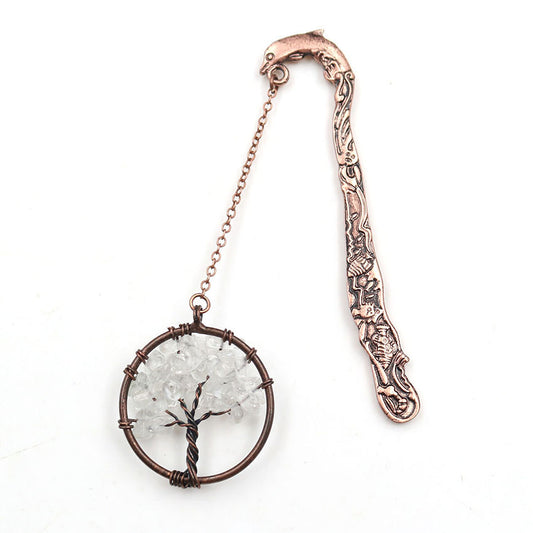
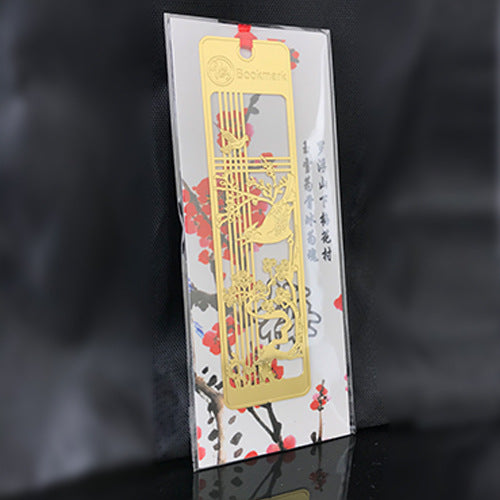
| Metal | Copper, silver, gilt, cloisonné | Hollow engraving, intricate patterns | Officials, wealthy | Wealth, luck |
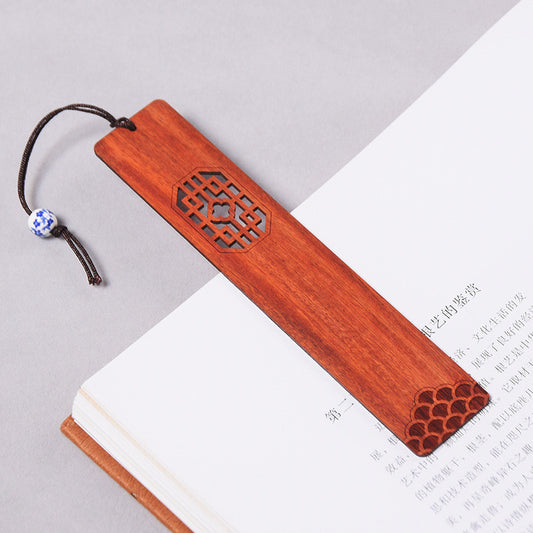
| Wood/Bamboo | Zitan, huali, bamboo | Natural grain, carving/heat‑transfer | Common scholars | Integrity, steadiness |
| Paper/Silk | Xuan paper, silk, brocade | Painted, printed, embroidered | General readers | Art, accessibility |
4. Historical Timeline
| Period | Book Form | Bookmark Type | Function | Materials |
|---|---|---|---|---|
| Han‑Tang | Scrolls | Scroll‑end tags | External ID/classification | Ivory, jade, wood, bone |
| Late Tang‑Song | Folded/whirlwind | Cover floating marks | Transition: title ID + early progress | Silk, paper strips |
| Ming‑Qing | Thread‑bound | Internal bookmarks | Progress marking | Diverse: ivory, jade, metal, wood, paper |
| Modern | Paperback/hardcover | Mass‑produced | Universal progress marking | Paper, plastic, metal, fabric |
5. Traditional Patterns & Symbolism
Animal Motifs
- Dragon: power, luck; Phoenix: blessing, rebirth; Crane: longevity; Deer: wealth; Butterfly: love; Fish: abundance, Chinese Zodiac Bookmarks.
Plant Motifs
- Plum: resilience; Lotus: purity; Peony: wealth; Bamboo: integrity; Orchid: elegance; Chrysanthemum: longevity
Cultural Symbols
- Chinese knots: unity; Clouds: auspiciousness; Bagua: balance; Calligraphy/poetry: literacy
6. Cultural Importance of Chinese Bookmarks
- Status Symbol: Premium materials (ivory, jade) signaled elite standing.
- Gift Culture: Engraved/poetic bookmarks expressed scholarly regard.
- Reading Ritual: Enhanced reverence for knowledge.
- Art Fusion: Integrated calligraphy, painting, carving, metalwork—highly collectible.
7. Frequently Asked Questions (FAQ)
Q1: When did Chinese bookmarks originate?
A1: Prototypes (scroll tags) appeared in the Han Dynasty. Internal bookmarks emerged in the Song and matured in the Ming‑Qing.
Q2: What materials were used?
A2: Ivory (royal), jade (scholars), metal (wealthy), wood/bamboo (common), paper/silk (general).
Q3: Why color‑coded tags?
A3: Tang‑Song imperial libraries used colors to classify texts (e.g., classics vs. history) for efficient management.
Q4: How do traditional vs. modern differ?
A4: Traditional: external ID → internal marker; premium craftsmanship; elite use. Modern: mass‑produced; universal progress focus.
Q5: How to authenticate antique bookmarks?
A5: Check material aging (ivory “cracks,” metal patina), hand‑carved irregularities, natural wear, and period‑style patterns/script.
Q6: Are antique bookmarks collectible?
A6: Yes—Ming‑Qing ivory/jade, master‑carved, and imperial examples command high value ($1,000–$10,000+).
Conclusion
The evolution of Chinese bookmarks mirrors bookbinding, reading habits, and aesthetic taste. From Han scroll tags to Ming‑Qing internal markers, these small objects became cultural symbols—blending utility, art, and the Chinese pursuit of beauty and knowledge.